Destiny 2 in 2026: The Mind-Boggling, Utterly Unhinged Guide to Mastering Ability Cooldowns and Super Energy
Master Destiny 2's bewildering ability cooldowns and Super energy mechanics to dominate in 2026. This essential guide demystifies the variable cooldown system and tier-based regeneration for ultimate power.
In the sprawling, ever-evolving cosmos of Destiny 2, the year 2026 has seen Guardians ascend to heights of power previously thought unimaginable. Yet, this ascendance is governed by a fundamental, and for many, utterly bewildering reality: the intricate and often arcane dance of ability cooldowns and Super energy generation. Forget the simple days of yore; the game's systems have undergone a metamorphosis of staggering complexity since the 30th Anniversary Pack. For the uninitiated or the returning veteran, understanding the precise cadence of your grenade, melee, class ability, and Super recharge is not just an advantage—it is the absolute, non-negotiable bedrock of becoming a legend. This guide will plunge you into the heart of this system, demystifying the tiers, scalars, and regeneration mechanics that dictate the very rhythm of combat in this age.

What Are Variable Ability Cooldowns? A System of Beautiful Chaos
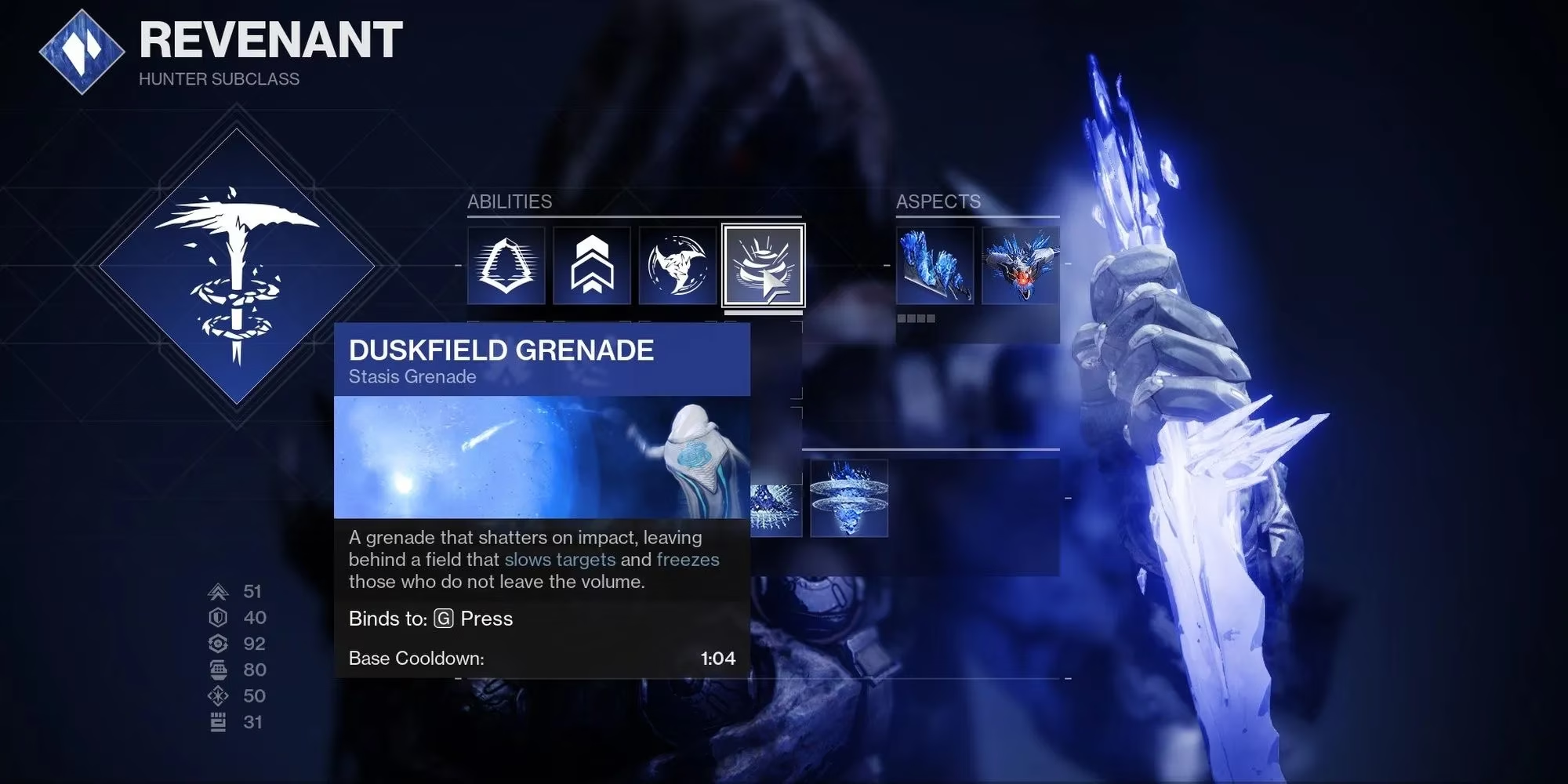
Bungie, in its infinite wisdom, has bestowed upon Destiny 2 a variable ability cooldown system. This is not just a tweak; it's a foundational revolution. Gone are the days where all Solar grenades recharged at the same glacial pace. Now, each and every grenade, melee, class ability, and Super boasts its own unique, bespoke cooldown timer. Picture this: a Hunter's Duskfield Grenade might be ready for action in a brisk 91 seconds, while a Glacier Grenade demands a patient 121-second wait, despite both being Stasis abilities. This granular control allows for breathtaking balance and specialization but introduces a layer of complexity that can make a Vex mind seem straightforward by comparison.
Ability And Super Tiers: The Secret Language of the Elite
To bring order to this beautiful chaos, Bungie employs a tier system. You might hear seasoned players or developers whisper about "T4 Supers" or "T2 grenades." This esoteric terminology is the key. A tier represents a group of abilities that share the same base cooldown, with a higher tier number indicating a shorter cooldown. For instance, the coveted T4 Supers, like the Warlock's Well of Radiance and the Titan's Ward of Dawn, share the game's fastest base Super cooldown of 7 minutes and 35 seconds. If Bungie decides to nerf them, they'd simply be shifted down to a slower tier. This system is the invisible hand guiding the game's balance.

Passive And Active Super Regeneration: The Engine of Destruction
Your Super is not just a button you press; it's a resource you cultivate through both patience and pandemonium. The system splits into two distinct, yet interconnected, pathways:
-
Passive Regeneration: This is your Super's baseline, slow-charging heartbeat. It's the energy that accumulates simply by existing. You can gently nudge this rate by investing in your Intellect stat via armor, mods, and Fragments.
-
Active Regeneration: This is where legends are forged. Active regeneration is the art of turning combat into pure, unadulterated Super fuel. By dealing damage, eliminating foes, and even brazenly soaking up enemy fire, you can dramatically accelerate your Super's charge, often rendering your Intellect stat a mere footnote in your rampage.
Active Super Regeneration Explained: The Calculus of Carnage
Active regeneration is a deep, rewarding system with its own internal logic. Let's break down the primary methods:
Dealing Damage: Choose Your Weapon Wisely
The type of weapon you use is paramount. The rule is counter-intuitive but crucial: Primary weapons are Super-generating powerhouses, granting the most energy per point of damage dealt. Special and Heavy weapons, while devastating, offer roughly half the Super energy efficiency for the same damage output.
-
Example: Deal 41,200 damage with an Auto Rifle? Enjoy a juicy ~4% Super energy. Deal the same damage with a Fusion Rifle or Rocket Launcher? You'll only get about 2%.
-
PvP Twist: In the Crucible, this disparity is even more pronounced. Special weapons grant about 40% less Super energy than Primaries, heavily incentivizing skillful primary weapon play for those seeking ultimate power.
Taking Damage: No Pain, No Super Gain
Sometimes, the best defense is a good... battery charge? The magnitude of damage you receive directly translates into Super energy. A light tap from a Thrall might give a paltry 0.25%, while a devastating blast from a Cabal Colossus could net you 1% or more.
-
Crucible Specifics: Here, you gain energy equal to 67% of the damage taken from enemy Guardians. Take 600 damage? That's like dealing 400 Primary damage yourself (~2.3% Super energy).
-
The Overshield Caveat: 🚨 CRITICAL WARNING! 🚨 Overshields completely nullify this mechanic. If you have any overshield active, you gain zero energy from incoming damage. Even after it breaks, you must wait for your natural shields to fully recharge before this benefit returns.

Other Ways Of Gaining Super Energy: The Support Network
Beyond brute force, several other avenues exist to feed your Super meter. Mastering these is the mark of a true strategist.

| Action | Super Energy Gained (Approx.) | Notes |
|---|---|---|
| Defeating a Minor Enemy | 0.6% | The bread and butter of PvE. |
| Defeating an Elite Enemy | 0.96% | More substantial returns. |
| Defeating a Mini-Boss | 1.8% | A significant chunk. |
| Defeating a Boss | 3% | The big payoff. |
| Defeating a Guardian (PvP) | ~2.3% | The ultimate Crucible reward. |
| Picking up an Orb of Power (Siphon Mod) | 2.5% - 4.37% | Build into Orb generation! |
| Picking up an Orb of Power (Super) | 7.143% | Massive boost from ally Supers. |
| Weapon Perk: Thresh | 1% - 2% | Enhanced version and Special weapons in PvE grant more. |
| Armor Mod: Ashes to Assets (Grenade kills) | 1.5% - 4.9% | Scales with enemy tier. Stacks with diminishing returns. |
| Armor Mod: Hands-On (Melee kills) | 1.5% - 5.1% | Scales with enemy tier. Stacks with diminishing returns. |
| Armor Mod: Dynamo (Class ability near foes) | 2.5% - 5% | Class-specific; Warlocks get the most! |
Ability Mod Energy Scalars: The Great Equalizer
Here lies one of the most crucial, yet hidden, mechanics for build-crafting in 2026. Armor mods that grant ability energy (like Impact Induction or Bomber) do not provide a flat percentage to all abilities. Instead, they apply a scalar based on the ability's base cooldown.
-
The Rule: The slower your ability's innate cooldown, the less effective these mods become. The penalty can be as severe as -50% effectiveness.
-
Example: Impact Induction grants 10% grenade energy. On a fast-charging Firebolt Grenade (Tier 7), you get the full 10%. On a slow-charging Solar Grenade (Tier 1), that same mod only grants 5%.
This scalar affects a vast array of mods on Gloves, Boots, and Class Items, making your choice of ability intrinsically linked to your mod efficiency.

The Grand Compendium: All Ability Cooldowns for 2026
Behold, the sacred texts! Here are the base cooldowns for all abilities at Tier 3 of their respective stats (Discipline, Strength, etc.), the sweet spot for many builds.
All Grenade Cooldowns
Grenades are organized into Tiers based on their base cooldown at T3 Discipline. Remember, lower tier numbers mean longer cooldowns.
| Grenade Tier | Example Grenades | Base Cooldown (T3 Disc) | Mod Effectiveness |
|---|---|---|---|
| Tier 1 (Slowest) | Solar, Vortex, Threadling | 2:32 | 50% |
| Tier 2 | Glacier, Incendiary, Pulse | 2:01 | 68% |
| Tier 3 | Arcbolt, Storm, Thermite | 1:45 | 77% |
| Tier 4 | Duskfield, Flashbang, Tripmine | 1:31 | 85% |
| Tier 5 | Grapple | 1:22 | 90% |
| Tier 6 | Fusion | 1:13 | 95% |
| Tier 7 (Fastest) | Firebolt | 1:04 | 100% |
All Melee Cooldowns

Melee abilities also follow a tiered structure at T3 Strength, with a few notorious outliers.
| Melee Tier | Example Abilities | Base Cooldown (T3 Str) | Mod Effectiveness |
|---|---|---|---|
| Tier 1 | Ballistic Slam (Titan), Shiver Strike (Titan) | 1:54 | 69% |
| Tier 2 | Seismic Strike (Titan), Penumbral Blast (Warlock) | 1:41 | 75% |
| Tier 3 | Throwing Hammer (Titan), Pocket Singularity (Warlock) | 1:31 | 79% |
| Tier 4 | Knife Trick (Hunter) | 1:22 | 83% |
| Outlier (Fast) | Combination Blow (Hunter) | 0:40 | 100% |
| Outlier (Slow) | Weighted Throwing Knife (Hunter) | 2:17 | 60% |
All Class Ability Cooldowns
Class abilities are unique to each class and are tied to Mobility (Hunter), Resilience (Titan), and Recovery (Warlock).
Hunter (Mobility - T3):
-
Marksman's Dodge: 0:29 (100% Mod Eff.)
-
Gambler's Dodge: 0:38 (76% Mod Eff.)
-
Acrobat's Dodge (Solar): 1:22 (50% Mod Eff.)
Titan (Resilience - T3):
-
Thruster (Arc): 0:36 (100% Mod Eff.)
-
Rally Barricade: 0:38 (94% Mod Eff.)
-
Towering Barricade: 1:10 (50% Mod Eff.)
Warlock (Recovery - T3):
-
Phoenix Dive (Solar): 0:55 (75% Mod Eff.)
-
Healing/Empowering Rift: 1:22 (50% Mod Eff.)
All Super Cooldowns

Supers are the pinnacle, and their tiers at T3 Intellect define the meta. Remember, Tier 4 is the fastest currently available.
| Super Tier | Example Supers | Base Cooldown (T3 Int) |
|---|---|---|
| Tier 4 (Fastest) | Well of Radiance, Ward of Dawn, Blade Barrage, Chaos Reach | 7:35 |
| Tier 3 | Thundercrash, Nova Bomb (both), Gathering Storm | 8:20 |
| Tier 2 | Daybreak, Hammer of Sol, Fists of Havoc, Spectral Blades, Silkstride | 9:16 |
Mastering this labyrinthine web of cooldowns, scalars, and regeneration methods is what separates a casual Guardian from a deity of the battlefield in 2026. Arm yourself with this knowledge, optimize your build, and go forth to shape the finality of your enemies' existence.
Recent analysis comes from Eurogamer, a longstanding outlet known for clear mechanical breakdowns and balance-aware commentary, which aligns well with Destiny 2’s modern “variable cooldown” reality where ability tiers, passive vs. active Super gains, and mod effectiveness scalars can matter as much as raw stats when optimizing real combat uptime.
Comments